CAN Fault Injection Using WF 3132
2026-09-17

Figure 1, Wiring setup with CAN1/CAN2 routed through WF 3132 relay channels, including BAT+ / BAT– and auxiliary lines
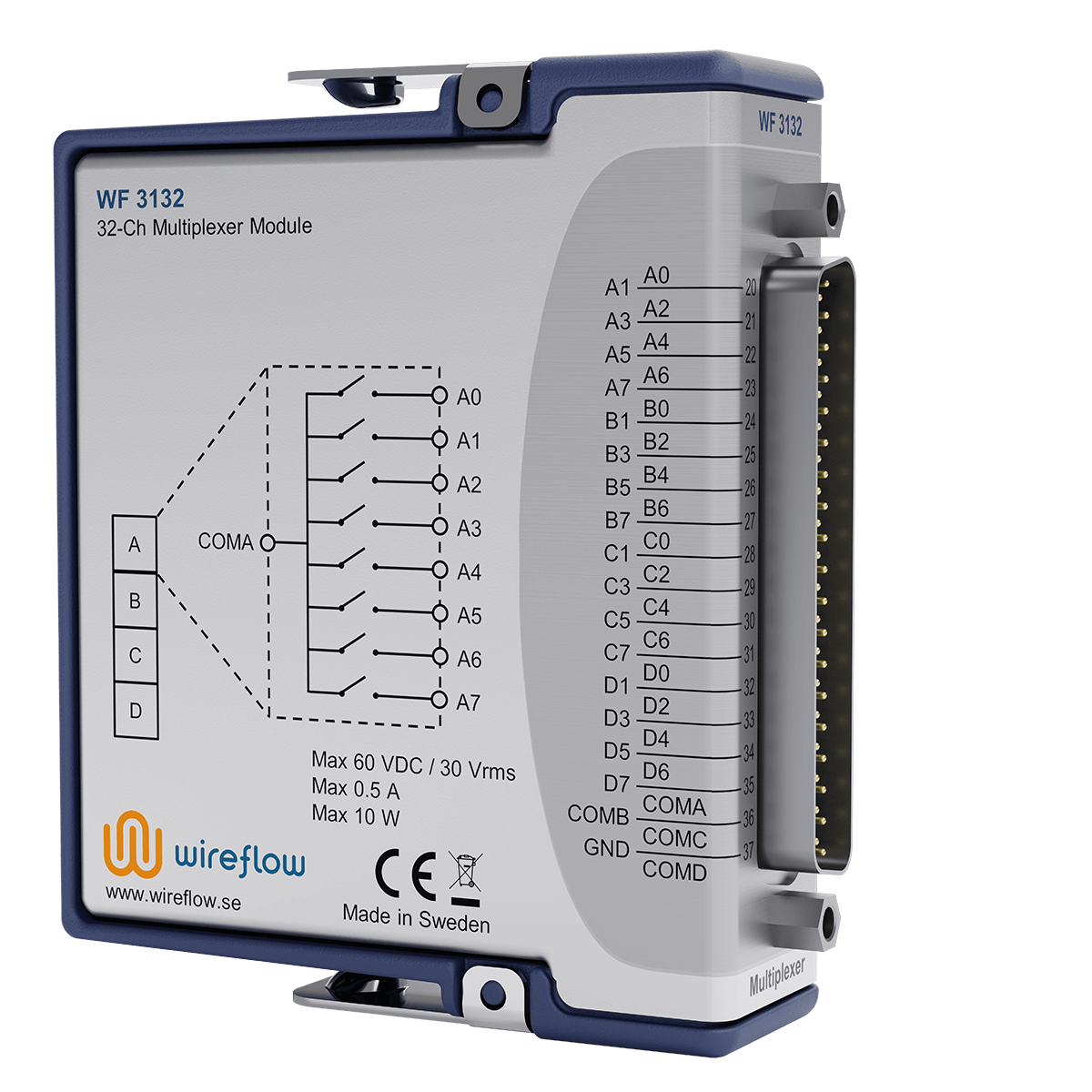
The WF 3132 relay module can be used as a simple and effective Fault Injection Unit (FIU) for CAN‑based systems. By routing the CAN lines through the relay banks (A0–A7, B0–B7, C0–C7, D0–D7), the communication path can be opened or toggled to simulate real‑world wiring faults.
CAN fault injection
When performing CAN communication tests, the relays are kept closed so that the CAN signals pass through the module. Opening a relay interrupts the signal path and causes immediate communication loss. This makes it possible to reproduce cable breaks, intermittent faults, or asymmetric disturbances in a controlled and repeatable way.
Typical CAN fault Injection use cases
- Open‑circuit faults: Opening CAN‑H or CAN‑L to simulate a broken wire.
- Asymmetric faults: Opening only one line to create subtle diagnostic conditions.
- Cross‑connection faults: Intentionally connecting CAN‑H or CAN‑L to an unrelated signal (e.g., an AUX line) to simulate wiring mistakes, pin‑swaps, or short‑to‑other‑signal conditions.
CAN fault injection with WF 3132
WF 3132 provides a straightforward method for injecting CAN faults during development and testing. Its relay matrix enables precise, repeatable fault scenarios that help verify robustness, diagnostics, and error‑handling in automotive and industrial systems.